

Pro-Seer
AvailableSteady-state and time-stepped water treatment process simulation, with results checked against water quality regulations.
Overview
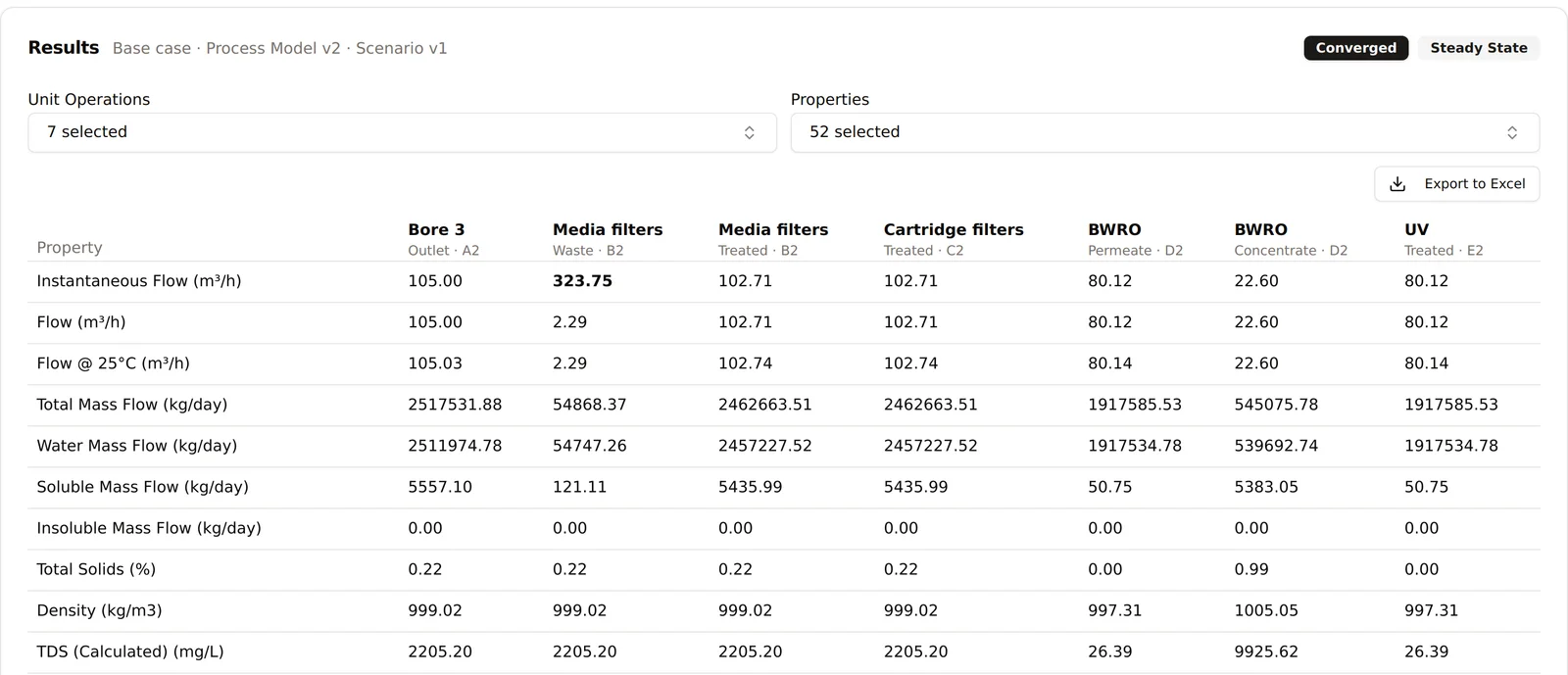
You describe the feed water, draw the treatment train as a flow diagram of unit operations, set operating scenarios and run the simulation. Pro-Seer carries the water chemistry through every unit with PHREEQC speciation and reports treated-water quality against the regulatory framework you choose.
Who it's for: Process engineers doing option studies, concept and detailed design, or troubleshooting existing plants across potable, industrial, wastewater and reuse.

Product line
- Pro-Seer Q: process simulation, as described on this page. Available now.
- Pro-Seer S: equipment sizing, specification and vendor-ready RFQs generated from a validated process design. In development, not yet available.
- Pro-Seer X: capital, operating and lifecycle cost evaluation built on the same process model, for comparing options. In development, not yet available.
Workflow
- Project (facility) → feed water quality → model (flow diagram) → scenario (operating parameters) → simulation.
- Feed water defined by analytes, pathogens and radionuclides.
- Several scenarios per model, so options and operating cases can be compared side by side.
- Result bundles can be exported and are digitally signed (Ed25519), so a copy can be checked against the original run.
Unit operations
- Clarification: settling ponds; lamella, horizontal-flow, solids-contact and sand-ballasted clarifiers; DAF; hydrocyclones.
- Filtration: gravity and pressure media filters, cartridge filters.
- Membranes: reverse osmosis, nanofiltration, pressurised and submerged UF, electrodialysis reversal, electrodeionisation.
- Sorption and ion exchange: adsorption media vessels, ion exchange vessels.
- Oxidation and disinfection: ozone, UV, chlorination and chloramination, contact tanks.
- Biological: activated sludge, aerated lagoons, MBR, MABR, trickling filters, RBCs, UASB, anaerobic digesters, septic tanks, and BNR configurations (MLE, UCT, SBR, MBBR, oxidation ditch, anammox).
- Thermal: falling- and rising-film evaporators, forced-circulation crystalliser, evaporation ponds, cooling towers, boilers.
- Solids handling, storage and transfer: thickeners, centrifuges, filter presses, drying beds, tanks, equalisation, screens, splitters, mixers, degassers, chemical dosing.
Chemistry and biology
- Speciation by PHREEQC (USGS), with the phreeqc, wateq4f, minteq, llnl, pitzer and sit databases. Pitzer covers high-salinity brines.
- Scale-mineral saturation, redox, oxidant and disinfection by-product reactions, coagulation, sorption and antiscalant effects.
- Activated sludge models ASM1, ASM2d and ASM3, anaerobic digestion model ADM1, and the ASM–ADM interfaces.
- Time-stepped runs with flow schedules, variable-level tanks and events, alongside steady-state runs.
Regulatory checks
- Australian Drinking Water Guidelines (ADWG) and ANZECC.
- US EPA, WHO, EU Drinking Water Directive, UK Drinking Water Regulations, Canadian GDWQ, Japanese Waterworks Law, China NDWQS.
- USP Purified Water and Water for Injection, SEMI ultrapure water, and a food & beverage framework.
- Limits can be overridden per project, and disinfection by-products, emerging contaminants and radiologicals can be switched on or off.
Limitations
What it doesn't do, or does only with conditions.
- A simulation is only as good as the feed-water analysis. Pro-Seer shows a live cation/anion charge balance as you enter the water quality, so a bad analysis is visible before you run anything.
- Unit models are design and screening models. They don't replace vendor projections for membrane warranties or pilot testing for novel applications.
- Biological models need calibrating to plant data before you rely on them for effluent compliance.
Other products